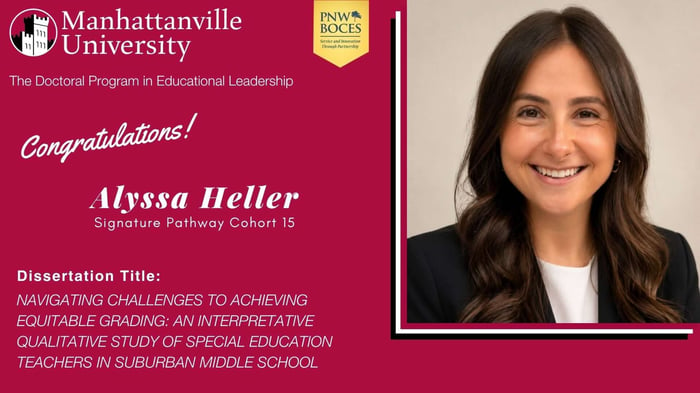
Congratulations to Alyssa Heller who on June 25, 2026, successfully defended her dissertation.
The title of Alyssa’s dissertation is, “NAVIGATING CHALLENGES TO ACHIEVING EQUITABLE GRADING: AN INTERPRETATIVE QUALITATIVE STUDY OF SPECIAL EDUCATION TEACHERS IN SUBURBAN MIDDLE SCHOOL.”
The abstract of this study follows:
Overview of the Problem: Although federal initiatives such as the Every Student Succeeds Act (ESSA) and guidance from the Office of Special Education Programs (OSEP) promote educational equity, grading practices for students with disabilities (SWDs) remain inconsistent and often inequitable. Traditional systems emphasize compliance and performance over individual growth, disadvantaging SWDs and misrepresenting their learning. Special education teachers (SETs) often interpret grading policies independently, striking a balance between fairness, accountability, and inclusion in their classrooms.
Research Purpose: This interpretive qualitative study aimed to understand how SETs navigate the challenges of achieving equitable grading practices for SWDs in middle school inclusive classrooms.
Research Design: Drawing upon Weick's (1995) sensemaking theory, this study explored how SETs interpreted grading practices and applied that understanding to their grading decisions.
Sample: Criterion-based sampling included 19 SETs from suburban middle schools in New Jersey and New York with valid teaching licenses, master’s degrees, and coteaching experience in inclusive classrooms.
Data Collection and Analysis: Data were collected through semi-structured interviews and district grading policy documents and analyzed through an inductive, iterative process that generated three themes.
Findings/Results: SETs balanced institutional expectations for grading consistency with individualized student needs, relying on professional judgment due to limited policy guidance. District policies provided minimal direction for inclusive grading, requiring independent interpretation. Although coteaching influenced decisions, participants reported no targeted professional development. SETs adapted assessments, emphasized student growth, and navigated inconsistent reassessment practices across settings.
Conclusions/Implications: Grading equity for SWDs cannot rest solely on SETs. Variability in practice reflected unclear policies, inconsistent coteaching structures, and a lack of professional development. SETs continuously navigated competing expectations while prioritizing student needs, underscoring the sensemaking demands of inclusive practice. Systemic support is needed through clearer policies and joint professional development.
Dissertation Committee Chair:
Dr. Kenneth Mitchell
Dissertation Committee Members:
Dr. Martin Fitzgerald
Dr. Lynn Allen

Take Your Career to the Next Level
Elevate your leadership skills, deepen your understanding of critical and contemporary education issues, and learn to help solve the current challenges in P-20 education.
Learn to Inspire Change
The Doctoral Program in Educational Leadership from Manhattanville, offered in partnership with Putnam Northern Westchester BOCES, utilizes a forward-thinking approach to educational leadership that is ideal for practicing and aspiring leaders in any educational context. It is designed to support the goals of educational professionals who seek to develop their leadership skills for career advancement or current job enhancement.